Arizona, USA
Historic mines produce blue, green, and matrix-rich turquoise.
Semi-Precious gemstone profile
A Historic Blue-Green Hydrated Phosphate
Turquoise is an opaque hydrated copper-aluminum phosphate valued for blue to green color and natural matrix patterns. Its porosity and moderate hardness make stabilization and dye disclosure especially important.
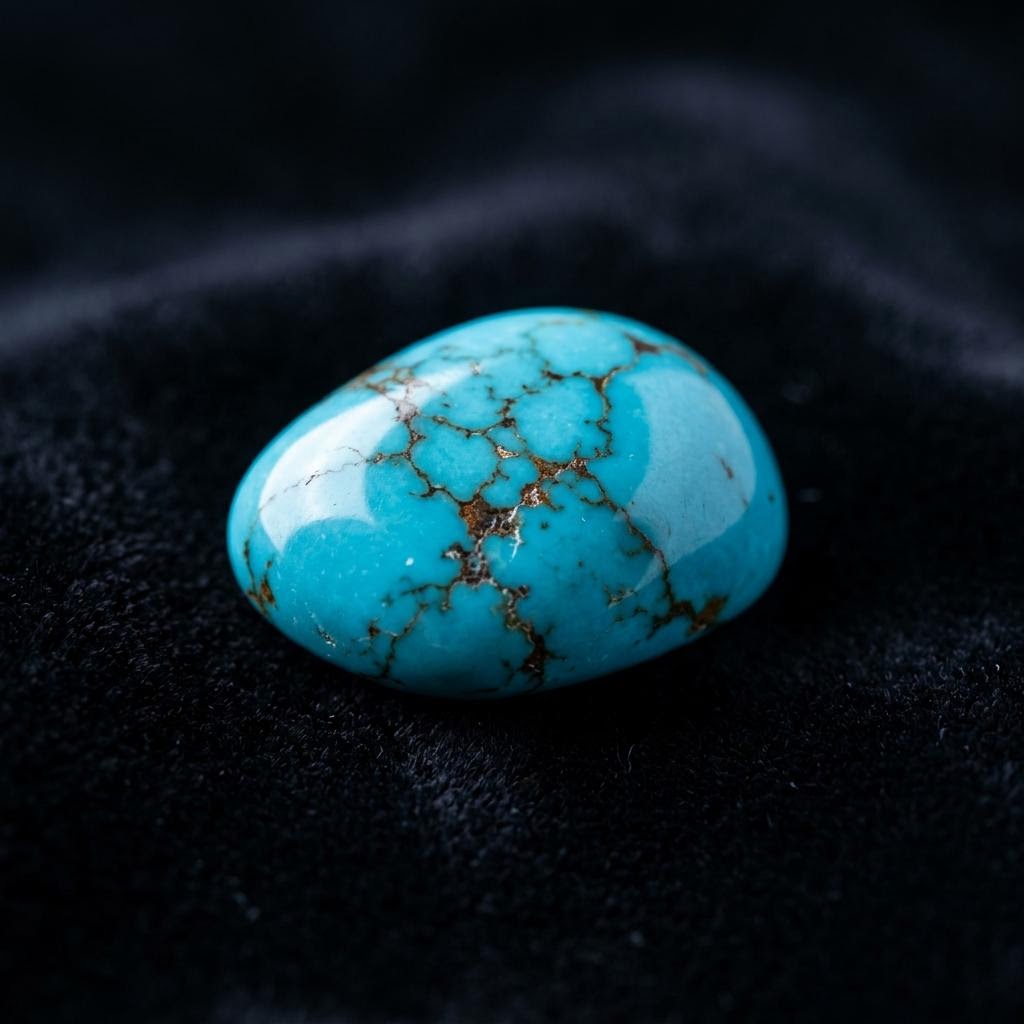
A practical field note on what Turquoise is made of, how it forms, how light behaves inside it, and what professionals look for when identifying it.
Browse the plain-language gemstone glossary or learn how to read a lab report.
Representative source regions, not a map of every occurrence.
Historic mines produce blue, green, and matrix-rich turquoise.
Historic source of prized blue turquoise, formerly called Persian turquoise.
Modern source with a broad range of blue-green material.
Color is shaped by chemistry, structure, inclusions, and light. These are representative varieties—not a promise that every stone will show every shade.
Vivid blue turquoise with relatively little iron-driven green.
A common natural range between sky blue and green, influenced by copper and iron.
Higher iron and lower copper can shift the bodycolor toward green.
Natural host-rock matrix remains visible as veins or patches.
Gemstones have rich symbolic histories. The claims below are presented as folklore, cultural tradition, or modern pseudoscience—not as proven medical, psychological, or supernatural effects.
Historical lens
Its blue-green color and scarcity made it a powerful cultural symbol, but traditions differ by community.
Historical lens
This is amuletic folklore, not evidence that the stone prevents accidents or illness.
Gemological properties can be measured and tested. Symbolic meaning is personal and cultural; crystals should never replace qualified medical or mental-health care.
Turquoise has been mined in the Sinai Peninsula since at least 3000 BCE and was used in Egyptian jewelry, Persian art, Indigenous North American adornment, and trade across Central Asia.
Turquoise has long been used as a protective amulet and symbol of health, travel, friendship, or sacred connection in many cultures. These associations are cultural or spiritual traditions, not scientifically demonstrated effects.
Cultural meanings and historical beliefs are included for context. They are not scientific evidence or medical advice.
Folklore and modern spiritual practices attach symbolic meanings to Turquoise. Those beliefs are presented as cultural history, not as medical guidance or evidence of physical effects.
This section records cultural history and folklore. These stories are not scientific evidence or medical guidance.
Ask whether the stone is natural, stabilized, dyed, or reconstituted. Keep turquoise away from perfumes, oils, heat, and harsh cleaners; store it separately because its surface can scratch.
Identity: Turquoise is a hydrated copper aluminum phosphate. It ranges from sky blue to green, often with matrix (remnants of host rock).
Color, Clarity & Cut: Persian (Iranian) robin's-egg blue with no matrix is historically most prized, but spiderweb matrix is highly valued by many collectors.
Treatments: Most commercial turquoise is stabilized (infused with resin) to improve durability and color. Dyeing and reconstitution (pressing dust into blocks) are also common. Look-alikes include dyed howlite and plastic imitations.
Care & Wear: Soft (Mohs 5-6) and porous. Keep away from perfumes, cosmetics, heat, and household chemicals. Do not clean with ultrasonic or steam.
Report Considerations: Lab testing can confirm whether the turquoise is natural, stabilized, or an imitation (like dyed magnesite or howlite).
Browse our current, authentic collection of natural turquoises on eBay.