Brazil
Large geodes and crystals from Rio Grande do Sul and Minas Gerais.
Semi-Precious gemstone profile
A Purple Quartz of Royal & Ritual History
A purple variety of quartz ranging from pale lilac to deep, rich purple. Once valued alongside ruby, amethyst is associated with sobriety and calm in historical and modern spiritual traditions—not demonstrated psychological effects.
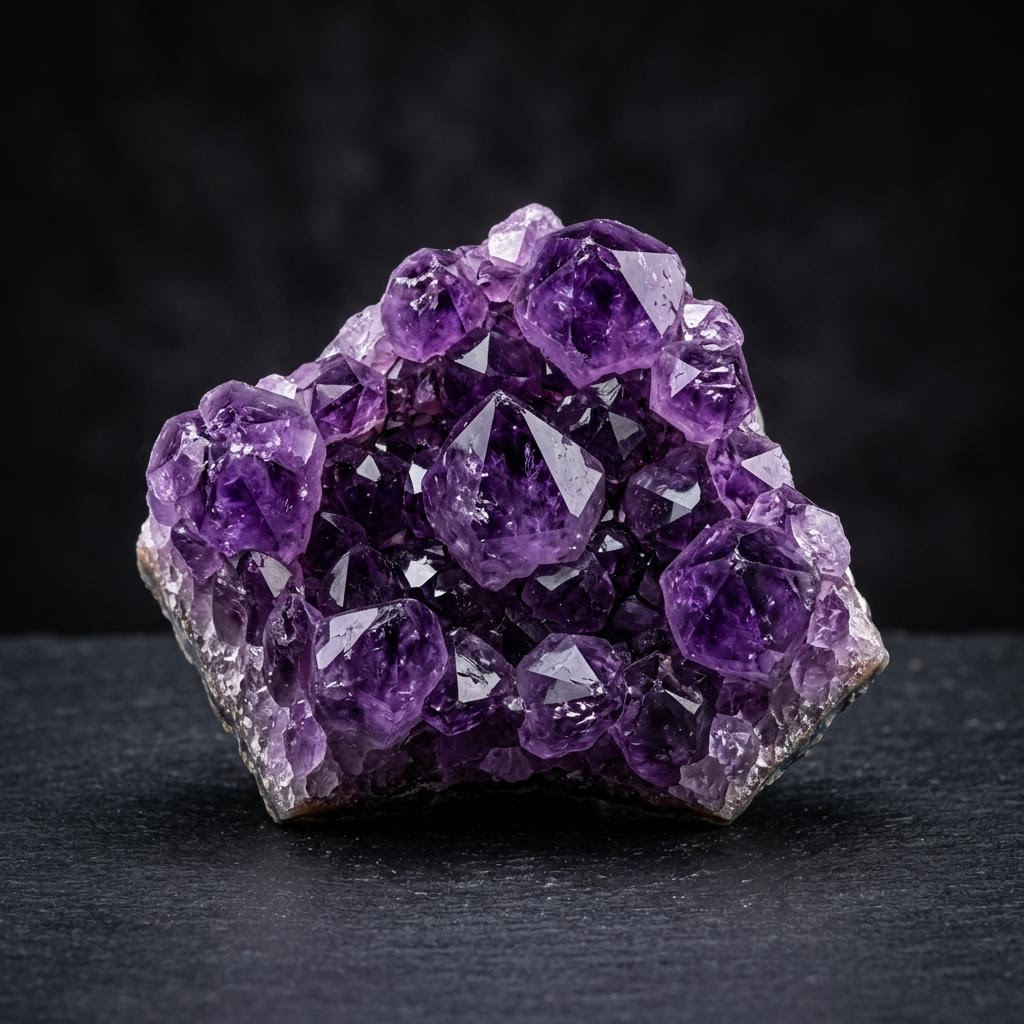
A practical field note on what Amethyst is made of, how it forms, how light behaves inside it, and what professionals look for when identifying it.
Browse the plain-language gemstone glossary or learn how to read a lab report.
Representative source regions, not a map of every occurrence.
Large geodes and crystals from Rio Grande do Sul and Minas Gerais.
Known for intensely saturated deep purple amethyst.
Often produces smaller crystals with strong color.
Historic source, especially the Urals.
Anahi mine is known for ametrine and purple quartz.
Color is shaped by chemistry, structure, inclusions, and light. These are representative varieties—not a promise that every stone will show every shade.
Light violet quartz often shows a delicate, airy tone.
Balanced violet is common in fine commercial amethyst.
Darker tone can be highly saturated but should still retain brightness.
A red-violet cast may be prized in some Brazilian material.
Usually heat-treated prasiolite rather than naturally purple amethyst.
Gemstones have rich symbolic histories. The claims below are presented as folklore, cultural tradition, or modern pseudoscience—not as proven medical, psychological, or supernatural effects.
Historical lens
The myth connects the stone's purple color with wine and Dionysian stories.
Historical lens
Its symbolism often centered on sobriety, spiritual focus, and restraint.
Historical lens
There is no reliable evidence that a quartz crystal changes sleep, anxiety, or intoxication.
Gemological properties can be measured and tested. Symbolic meaning is personal and cultural; crystals should never replace qualified medical or mental-health care.
The name comes from "amethystos" (not drunk) in Greek. The Greeks carved drinking vessels from amethyst believing it would prevent intoxication. Dionysus, god of wine, plays a central role in amethyst mythology.
Medieval bishops wore amethyst rings as symbols of piety and celibacy (purple being a royal color associated with Christ's wounds). Amethyst appears in the biblical breastplate of Aaron, representing the tribe of Dan. Cardinal rings are traditionally amethyst.
Until the 19th century, amethyst was one of the five cardinal gemstones, as precious as ruby and sapphire. The discovery of massive deposits in Brazil in the 19th century made amethyst abundant and affordable, shifting its category to "semi-precious."
Despite Brazil's abundance, the finest amethyst today comes from Siberia, Uruguay, and Zambia—displaying deep "Siberian" purple with red and blue flashes that command significant premiums.
Amethyst is deeply embedded in the history of royalty and religion. Catherine the Great was famously fond of it. In Tibet, amethyst is considered sacred to Buddha, and prayer beads are often fashioned from it. In modern metaphysical circles, it is the primary stone for the crown chakra, believed to enhance spiritual awareness and promote a calm mind.
Cultural meanings and historical beliefs are included for context. They are not scientific evidence or medical advice.
The central myth involves Dionysus (Bacchus), enraged after being insulted, vowed that the next person he met would be eaten by tigers. A young virgin named Amethyst was on her way to worship at Artemis' shrine. Artemis turned her to pure white quartz to protect her. Dionysus, overcome with remorse, wept wine-tears that stained the crystal purple. Leonardo da Vinci believed amethyst increased intelligence and protected against evil thoughts.
This section records cultural history and folklore. These stories are not scientific evidence or medical guidance.
The finest amethyst shows a deep, slightly reddish-purple or 'Siberian' color without visible brown or gray. Zambian amethyst is known for deep saturation; Brazilian for lighter, more even color in larger crystals. Avoid 'heated' amethyst that turns yellow (citrine)—this is sold legitimately but should be disclosed. Synthetic amethyst exists and is virtually impossible to distinguish from natural without lab testing; for significant purchases, request GIA or AGL certification. Amethyst is stable in light but prolonged sun exposure can fade the color.
Browse our current, authentic collection of natural amethysts on eBay.