Australia
Lightning Ridge, Coober Pedy, and Queensland define major opal fields.
Semi-Precious gemstone profile
The Kaleidoscopic Gem That Plays With Light
A hydrated amorphous form of silica famous for its 'play-of-color'—flashes of rainbow hues. Requires gentle care due to its water content.
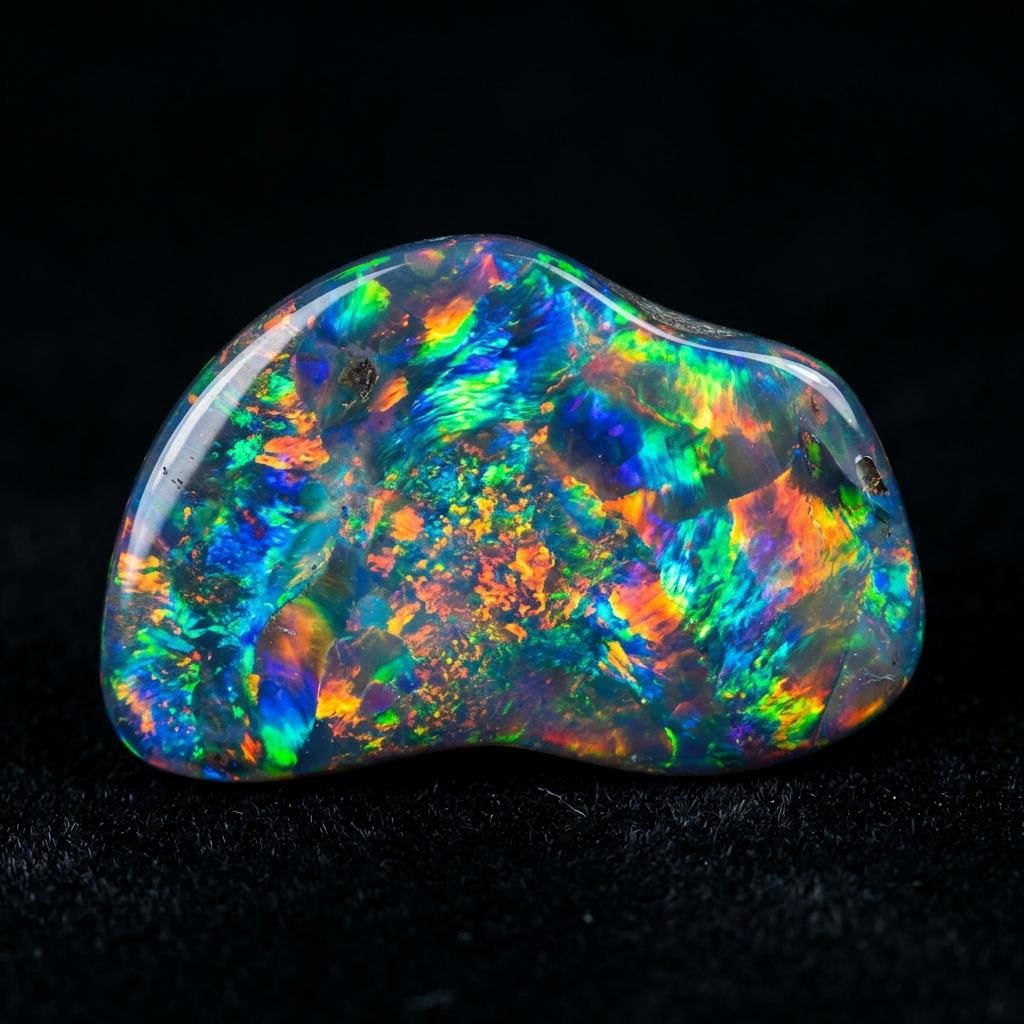
A practical field note on what Opal is made of, how it forms, how light behaves inside it, and what professionals look for when identifying it.
Browse the plain-language gemstone glossary or learn how to read a lab report.
Representative source regions, not a map of every occurrence.
Lightning Ridge, Coober Pedy, and Queensland define major opal fields.
Welo opal is often hydrophane and can show dramatic play-of-color.
Jalisco and Querétaro are known for orange and red fire opal.
Produces varied precious and common opal.
Nevada is famous for black and fire opal occurrences.
Color is shaped by chemistry, structure, inclusions, and light. These are representative varieties—not a promise that every stone will show every shade.
Dark body tone makes flashes of play-of-color appear especially vivid.
Light body tone with white, pastel, or bright spectral flashes.
Translucent body allows color play to glow within the stone.
Orange to red body color; it may or may not show play-of-color.
Natural ironstone matrix remains attached to the opal.
Gemstones have rich symbolic histories. The claims below are presented as folklore, cultural tradition, or modern pseudoscience—not as proven medical, psychological, or supernatural effects.
Historical lens
The stone's sudden spectral color likely inspired stories of celestial fire.
Historical lens
Its reputation shifted dramatically across time and place.
Historical lens
These claims are not supported by the physics of hydrated silica or clinical evidence.
Gemological properties can be measured and tested. Symbolic meaning is personal and cultural; crystals should never replace qualified medical or mental-health care.
The Romans prized opal above all other gems. Pliny the Elder wrote that opal contained the fire of carbuncle (ruby), the sea-blue of sapphire, the green of emerald—all blazing together. Senator Nonius was exiled by Mark Antony rather than give up his prized opal (size of a walnut). Romans called it "opalus."
Australia now produces 95%+ of the world's gem opals. Lightning Ridge produces the prized black opals; Coober Pedy produces crystal and white opals. The first opal rush began around 1890.
Ironically, while Romans treasured opal above all gems, a strange superstition arose in Victorian England—partly fueled by Sir Walter Scott's 1829 novel "Anne of Geierstein" in which a magical opal brought death—that opals were bad luck for anyone not born in October. This nearly destroyed the opal trade; Queen Victoria publicly wore and gifted opals to combat the superstition.
In modern times, opal represents hope, innocence, and purity. It is celebrated as the national gemstone of Australia. Opals have experienced a major resurgence in contemporary fine jewelry, favored by designers for their unique, unrepeatable color patterns that make every single stone distinctly individual.
Cultural meanings and historical beliefs are included for context. They are not scientific evidence or medical advice.
Arabic legend holds that opals fell from the sky during lightning storms. Ancient Australians (Aboriginal traditions) have the oldest opal legends: the Creator descended to Earth on a rainbow, and where his foot touched the ground, stones began to sparkle with all the colors of the rainbow—the first opals. In the Middle Ages, opal was called "Ophtalmios" (Eye Stone) and was believed to grant the power of invisibility.
This section records cultural history and folklore. These stories are not scientific evidence or medical guidance.
Opals are evaluated primarily on play-of-color: brilliance (brightness), pattern (harlequin is most prized), and number of colors displayed. Black opals (dark body tone with vivid play of color) from Lightning Ridge are the most valuable. Ethiopian Welo opals are hydrophane—they absorb water and can temporarily change appearance; some crack on drying, so test by soaking before purchase. Doublets and triplets (thin opal slices sandwiched with backing/caps) are legitimate but worth far less than solid opals; the layering is visible with a loupe from the side. Opals are sensitive to dehydration (store away from heat sources and rehydrate with mineral oil periodically).
Identity: Opal is a hydrated amorphous form of silica. Its internal structure diffracts light to create the flashes of color known as 'play-of-color'.
Color, Clarity & Cut: Evaluation depends on the intensity, pattern, and variety of colors in the play-of-color, against the body color (black, white, or transparent).
Treatments: Doublets and triplets (thin opal slices glued to backings) are common and evaluated differently than solid opal. Ethiopian opals are often smoked or dyed to darken body color. Synthetics exist.
Care & Wear: Very fragile (Mohs 5.5-6.5). Susceptible to scratching, thermal shock, and crazing (cracking) if dried out. Doublets will delaminate if soaked in water. Ethiopian opal (hydrophane) absorbs liquids and can temporarily lose its color.
Report Considerations: A lab report is useful to verify if the opal is natural, untreated, solid (not assembled), and to specify its geographic origin and body color.
Browse our current, authentic collection of natural opals on eBay.