Sri Lanka
Alluvial source of transparent multicolor andalusite.
Semi-Precious gemstone profile
Earth-Tone Pleochroism in a Durable Gem
Andalusite is a strongly pleochroic aluminum silicate that can show green, brown, gold, and reddish tones in one stone. Its characteristic cross-like color zoning is often visible in cushion and oval cuts.
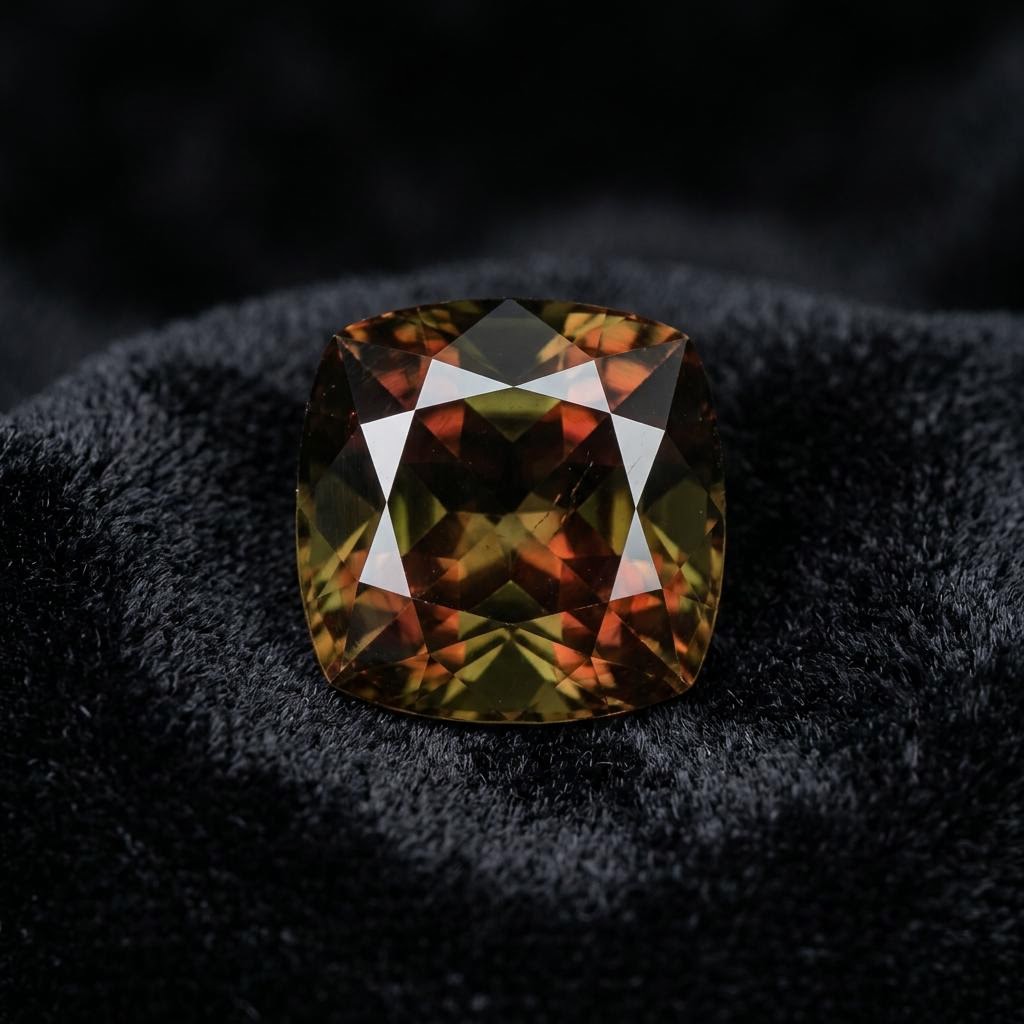
A practical field note on what Andalusite is made of, how it forms, how light behaves inside it, and what professionals look for when identifying it.
Browse the plain-language gemstone glossary or learn how to read a lab report.
Representative source regions, not a map of every occurrence.
Alluvial source of transparent multicolor andalusite.
Produces gem-quality material with strong pleochroism.
The name refers to Andalusia, a historic locality association.
Color is shaped by chemistry, structure, inclusions, and light. These are representative varieties—not a promise that every stone will show every shade.
Pleochroic green direction common in fine faceted andalusite.
Warm direction that may appear as the stone rotates.
Iron and manganese can create a rich russet pleochroic color.
Cross-like zoning can show green, gold, and brown in one face-up stone.
Gemstones have rich symbolic histories. The claims below are presented as folklore, cultural tradition, or modern pseudoscience—not as proven medical, psychological, or supernatural effects.
Historical lens
These meanings are modern interpretations of a real optical property.
Historical lens
That use is personal ritual, not a demonstrated psychological or medical effect.
Gemological properties can be measured and tested. Symbolic meaning is personal and cultural; crystals should never replace qualified medical or mental-health care.
Andalusite was named after Andalusia, Spain, although important gem material also comes from Sri Lanka and Brazil. Its pleochroism made it a subject of early optical study.
Its earth tones and cross-like zoning have inspired modern symbolic associations with balance, grounding, and perspective. These associations are cultural or spiritual traditions, not scientifically demonstrated effects.
Cultural meanings and historical beliefs are included for context. They are not scientific evidence or medical advice.
Folklore and modern spiritual practices attach symbolic meanings to Andalusite. Those beliefs are presented as cultural history, not as medical guidance or evidence of physical effects.
This section records cultural history and folklore. These stories are not scientific evidence or medical guidance.
Rotate the stone before buying because orientation controls the face-up color mix. Look for a pleasing balance of hues, clean facet junctions, and protection from sharp impacts.
Browse our current, authentic collection of natural andalusites on eBay.