Myanmar
Mogok is celebrated for vivid marble-hosted rubies.
Precious Gems gemstone profile
The King of Precious Gemstones
A red variety of the mineral corundum. Its fiery hue comes from trace amounts of chromium. The most valuable rubies historically originate from Burma.
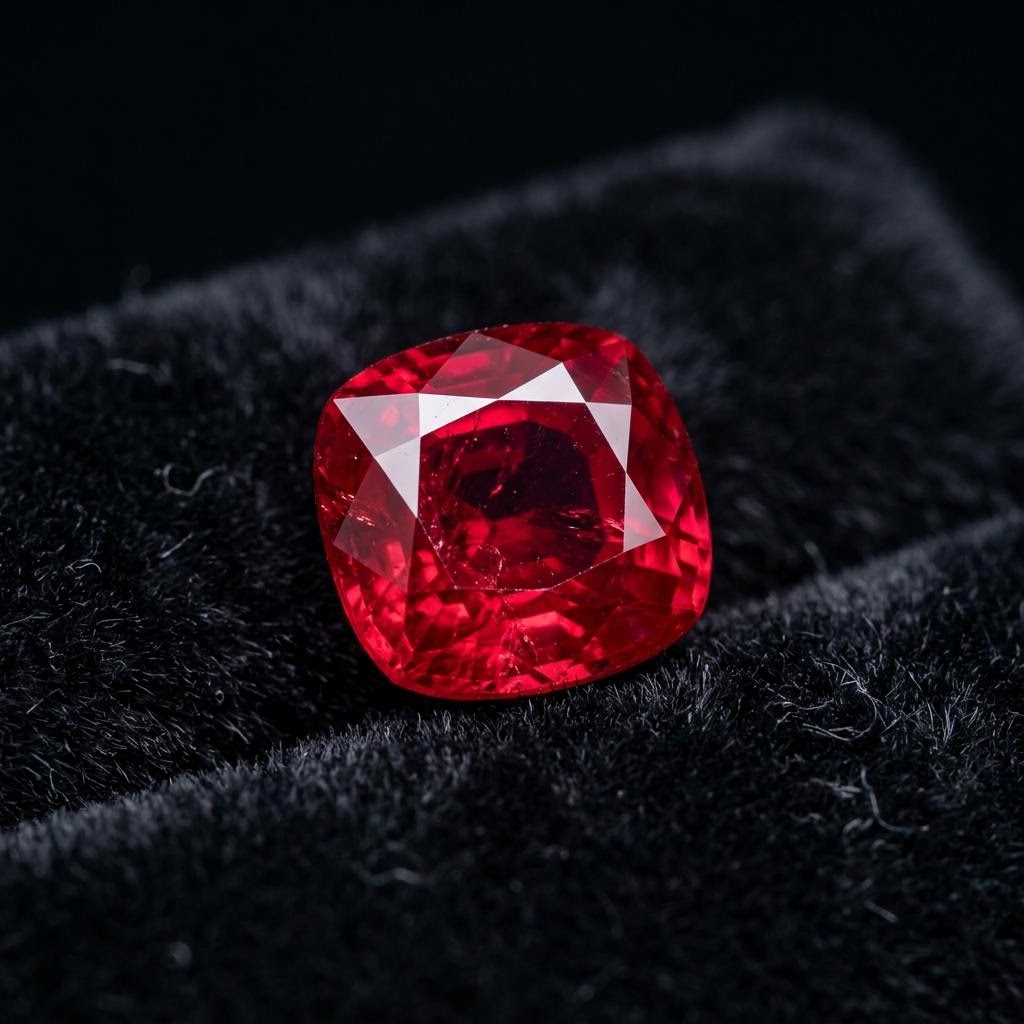
A practical field note on what Ruby is made of, how it forms, how light behaves inside it, and what professionals look for when identifying it.
Browse the plain-language gemstone glossary or learn how to read a lab report.
Representative source regions, not a map of every occurrence.
Mogok is celebrated for vivid marble-hosted rubies.
Montepéuez became an important source of fine rubies.
Historic source known for darker, often heat-treated material.
Alluvial deposits produce many lighter pinkish-red stones.
Luc Yen and Quy Chau produce marble-hosted rubies.
Color is shaped by chemistry, structure, inclusions, and light. These are representative varieties—not a promise that every stone will show every shade.
Vivid red with a subtle blue component; a trade description, not a universal lab grade.
Strong saturated red, often linked to chromium content.
Lighter tone may approach the ruby–pink sapphire boundary.
A cooler red influenced by hue mixture and lighting.
Warm red varieties can show iron-related color influence.
Gemstones have rich symbolic histories. The claims below are presented as folklore, cultural tradition, or modern pseudoscience—not as proven medical, psychological, or supernatural effects.
Historical lens
South Asian and European lapidary traditions treated the red glow as a sign of vitality and protection.
Historical lens
This is a historical talismanic belief, not an effect supported by materials science.
Historical lens
These symbolic associations can be meaningful personally, but they are not medical or physical effects.
Gemological properties can be measured and tested. Symbolic meaning is personal and cultural; crystals should never replace qualified medical or mental-health care.
The Sanskrit word for ruby is "ratnaraj" (king of gems). Ancient Burmese warriors implanted rubies under their skin believing it made them invincible in battle. The Mogok Valley in Burma has produced rubies for over 2,500 years.
Rubies are mentioned four times in the Bible (Proverbs, Job, Lamentations) as symbols of wisdom and virtue. Roman author Pliny wrote extensively about rubies in Natural History (77 CE). Roman merchants traveled to India and Sri Lanka along the Silk Road specifically to acquire rubies.
Islamic physicians used rubies to counteract poison, purify blood, and ward off plague. Marco Polo wrote that the King of Ceylon possessed a ruby "as long as a palm, as thick as a man's arm, flawless" which Kublai Khan tried to buy. Medieval European monarchs wore rubies as symbols of divine right.
The Mughals were obsessed with rubies. Emperor Shah Jahan (who built the Taj Mahal) inscribed rubies with prayers. The "Sunrise Ruby"—a Burmese pigeon-blood ruby—sold for $30.3 million in 2015.
Burma (Myanmar) pigeon-blood rubies remain the most valuable. Mozambique has emerged as a major source since 2009. Heat treatment is now standard for 95%+ of commercial rubies.
In Burmese culture, rubies were more than gems—they were talismans of war, love, and protection. The Burmese called the finest specimens "pigeon's blood" for their pure red with a hint of blue. In Indian culture, rubies represented the sun, bestowing power and protection on rulers. Chinese emperors decorated armor with rubies to ensure protection in battle. In European heraldry, rubies (called "carbuncles") represented courage and nobility. The ruby is one of the five cardinal gems of Hinduism.
Cultural meanings and historical beliefs are included for context. They are not scientific evidence or medical advice.
Ancient Hindus divided rubies into castes—the "true Oriental ruby" was the Brahmin (highest caste). Placing a ruby on an altar was said to bring the worshipper rebirth into a powerful caste. European legend held that the ruby's internal fire could not be hidden—it would glow through any wrapping. Rubies were said to warn their owners of impending danger by deepening in color.
This section records cultural history and folklore. These stories are not scientific evidence or medical guidance.
Pigeon-blood rubies from Myanmar (Mogok Valley) command the highest premiums—expect to pay 2–5× more than Thai or African rubies of similar size. Color is the primary value driver: look for pure red with no brown or orange overtone. Saturation should be vivid, not dark (overly dark rubies appear 'blackish' in low light). Almost all commercial rubies are heat-treated to improve color and clarity; this is fully acceptable and standard. Untreated rubies above 2 carats with AGL or GRS certification stating 'no heat' can sell for 3–10× the price of treated equivalents. Be cautious of fracture-filled rubies (filled with lead glass)—these have drastically reduced durability and value. Request a reputable lab certificate for any significant purchase.
Identity: Ruby is the red variety of corundum. The boundary between ruby and pink, purple, or orange sapphire can depend on laboratory and market conventions.
Color, Clarity & Cut: Color, transparency, clarity, cut, size, and treatment status interact in evaluation. Descriptive color terms are not standardized grades unless a report defines them.
Treatments: Heat treatment is encountered in the ruby market. Glass-filled and other fracture-filled material requires different disclosure, care, and evaluation. Look-alikes include red spinel, garnet, and red tourmaline.
Care & Wear: Ruby has high scratch resistance, but fractures, inclusions, fillings, settings, and prior repairs affect wear and cleaning safety. Filled material can be especially sensitive to heat and chemicals.
Report Considerations: For significant stones, a report from an independent laboratory helps verify natural origin, detect heat treatment, and rule out fracture filling. 'No heat' rubies are evaluated differently.
Browse our current, authentic collection of natural rubys on eBay.