Botswana
Major source of gem-quality stones from kimberlite pipes.
Precious Gems gemstone profile
The Hardest Natural Substance on Earth
The hardest known natural material on Earth, composed of pure carbon. Evaluated by the 4Cs: Cut, Color, Clarity, and Carat weight. The ultimate symbol of endurance and eternal love.
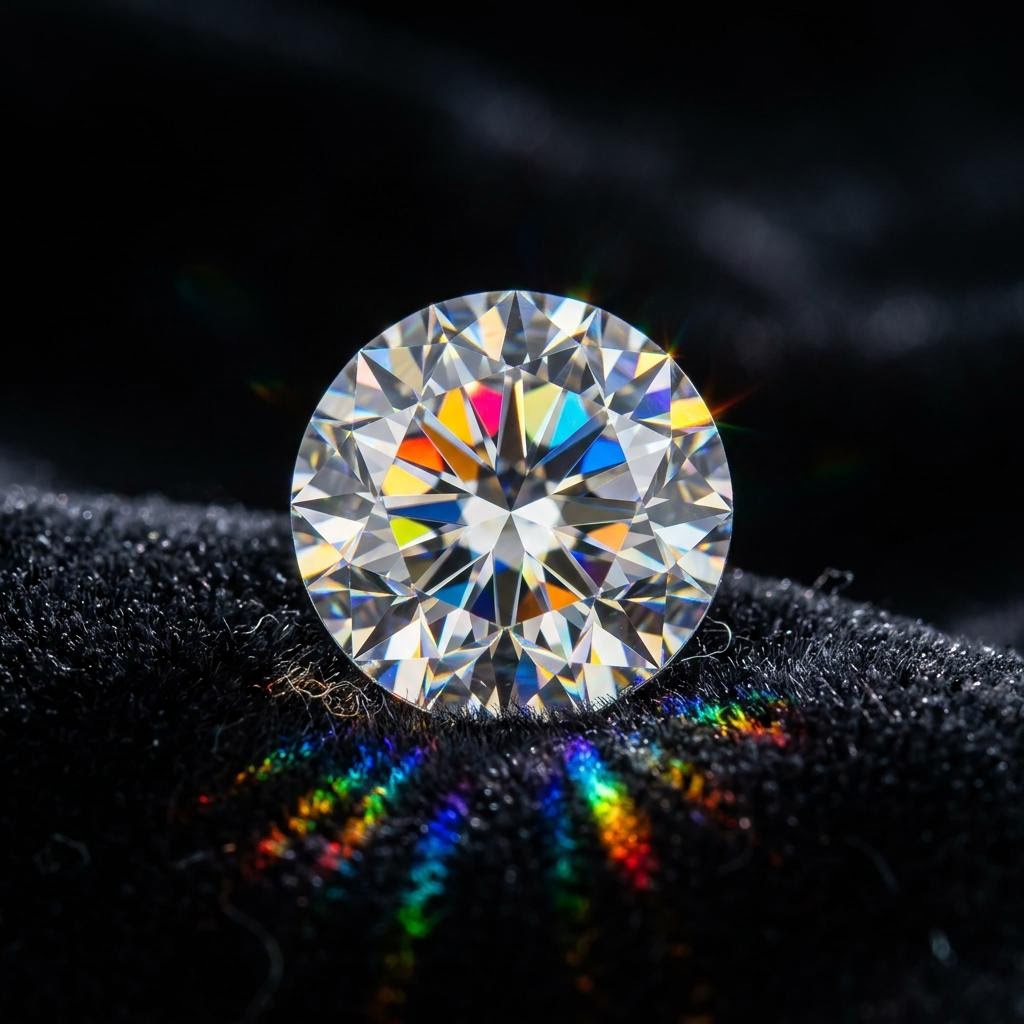
A practical field note on what Diamond is made of, how it forms, how light behaves inside it, and what professionals look for when identifying it.
Browse the plain-language gemstone glossary or learn how to read a lab report.
Representative source regions, not a map of every occurrence.
Major source of gem-quality stones from kimberlite pipes.
Large deposits across Siberia, especially Sakha.
Arctic mines known for traceable production.
The historic source that transformed modern diamond mining.
Argyle was famous for rare pink diamonds.
Historic alluvial source, including the Golconda region.
Color is shaped by chemistry, structure, inclusions, and light. These are representative varieties—not a promise that every stone will show every shade.
Pure-looking bodycolor; graded D–Z by the GIA scale.
Warm brown or golden tones caused by lattice defects.
Nitrogen-related absorption creates yellow to vivid yellow.
Boron in the crystal lattice gives many blue diamonds their color.
Usually linked to deformation in the crystal lattice, not a pink impurity.
Natural radiation can displace atoms and create green coloration.
Extremely rare; commonly associated with plastic deformation.
Gemstones have rich symbolic histories. The claims below are presented as folklore, cultural tradition, or modern pseudoscience—not as proven medical, psychological, or supernatural effects.
Historical lens
Ancient and medieval natural philosophy used supernatural origins to explain a mineral that seemed impossibly hard.
Historical lens
These talismanic traditions appear in European, South Asian, and Persian sources.
Historical lens
This is a spiritual practice, not a property demonstrated by gemological or medical research.
Gemological properties can be measured and tested. Symbolic meaning is personal and cultural; crystals should never replace qualified medical or mental-health care.
Diamonds first mined in Golconda, India. Called "vajra" (thunderbolt) in Sanskrit. Kautilya's Arthashastra described diamond trade. Indian artisans did not cut diamonds—they were valued in rough natural octahedral form.
Diamonds reached Europe via Arab traders. Believed to be hardened dew or fallen starlight. Medieval physicians ground diamonds into medicine. The Bishop of Rennes (1070 CE) wrote the earliest European diamond description.
Lodewyk van Berken of Bruges developed the diamond-polishing wheel (scaif) around 1456, enabling faceted cutting. The first brilliant-cut diamonds began appearing in Florentine courts. The Sancy Diamond was faceted during this period.
Brazil became the world's dominant source after 1730. The 4Cs grading system originated conceptually with Venetian goldsmiths but was formally codified by GIA in 1953. South Africa's Kimberley mines opened in 1871; Cecil Rhodes consolidated control into De Beers by 1888.
De Beers launched "A Diamond is Forever" in 1947, cementing the engagement ring tradition. Lab-grown diamonds introduced commercially in the 1950s. Today, Botswana, Russia, and Canada are leading sources.
Diamonds symbolize eternal love, invincibility, and purity across cultures. In Hindu tradition, a flawless diamond brought good fortune; a flawed one brought misfortune. Greek warriors wore diamonds into battle believing they conferred invincibility. European monarchies defined crown jewels by their diamonds—the British Imperial State Crown holds 2,868 diamonds including the Cullinan II. In Chinese culture, the diamond represents clarity of mind and is associated with longevity. Today, diamond engagement rings are a global tradition born primarily from 20th-century marketing.
Cultural meanings and historical beliefs are included for context. They are not scientific evidence or medical advice.
Ancient Hindus called diamonds "dew from heaven" and believed they were formed by lightning striking rocks. Greeks named the diamond after "adamas" (unconquerable) and believed Zeus used them to forge his thunderbolts. Medieval Europeans thought diamonds could only be dissolved in goat's blood, could detect poison by sweating, and could cure illness. Alchemists believed diamonds were the "philosopher's stone" in disguise.
This section records cultural history and folklore. These stories are not scientific evidence or medical guidance.
When purchasing diamonds, evaluate the 4Cs: Cut (most important for brilliance—round brilliant is the benchmark), Color (D–F colorless grades are premium; G–J offer value), Clarity (VS1–VS2 are eye-clean and recommended), and Carat weight (affects price exponentially, not linearly). Always request a GIA or AGS grading certificate. Avoid diamonds with fluorescence graded 'Very Strong' as this can cause a milky haze. Be aware that many online sellers offer 'enhanced' diamonds (fracture-filled or laser-drilled) at steep discounts—these are legitimate but worth less on resale. Lab-grown diamonds are chemically identical to natural diamonds but sell at 60–80% discounts; they are an excellent value choice but do not hold the same collector resale value.
Identity: Natural diamonds are carbon crystals formed in the earth. Laboratory-grown diamonds are produced in controlled environments and have properties corresponding to natural diamond. Simulants such as cubic zirconia and moissanite are different materials.
Color, Clarity & Cut: Cut strongly influences brilliance. Color and clarity preferences depend on the setting, lighting, size, and buyer priorities; grade labels should be interpreted in the context of the issuing laboratory's system.
Treatments: Common treatments include fracture filling and laser drilling. Major look-alikes are Moissanite and Cubic Zirconia.
Care & Wear: Diamond has high scratch resistance but can chip along cleavage planes. Before ultrasonic or steam cleaning, treatment status, inclusions, mounting security, and prior repairs should be reviewed by a qualified jeweler.
Report Considerations: A grading report is highly advisable for significant purchases. Ensure the report number is laser-inscribed on the girdle and matches the document.
Browse our current, authentic collection of natural diamonds on eBay.
Largest gem-quality rough diamond ever found (3,106 carats), discovered in South Africa in 1905. Cut into 9 major stones, the two largest—Cullinan I (530 ct) and Cullinan II (317 ct)—are set in the British Crown Jewels.
45.52-carat fancy deep blue diamond, now at the Smithsonian Institution. Believed stolen from a Hindu idol, it allegedly carried a curse. Owned by Louis XIV, then later by Henry Philip Hope, and finally donated by Harry Winston in 1958.
Meaning 'Mountain of Light,' this 105.6-carat diamond originated in India and passed through Mughal, Persian, Afghan, and Sikh rulers before being acquired by the British East India Company and set in the Queen Mother's Crown.