Colombia
Muzo and Chivor are classic sources of vivid, often low-iron emeralds.
Precious Gems gemstone profile
The Sacred Green Gem of Venus & Cleopatra
The green variety of the beryl family. Famous for internal characteristics known as 'jardin' (garden). Colombian emeralds are known for pure green hues.
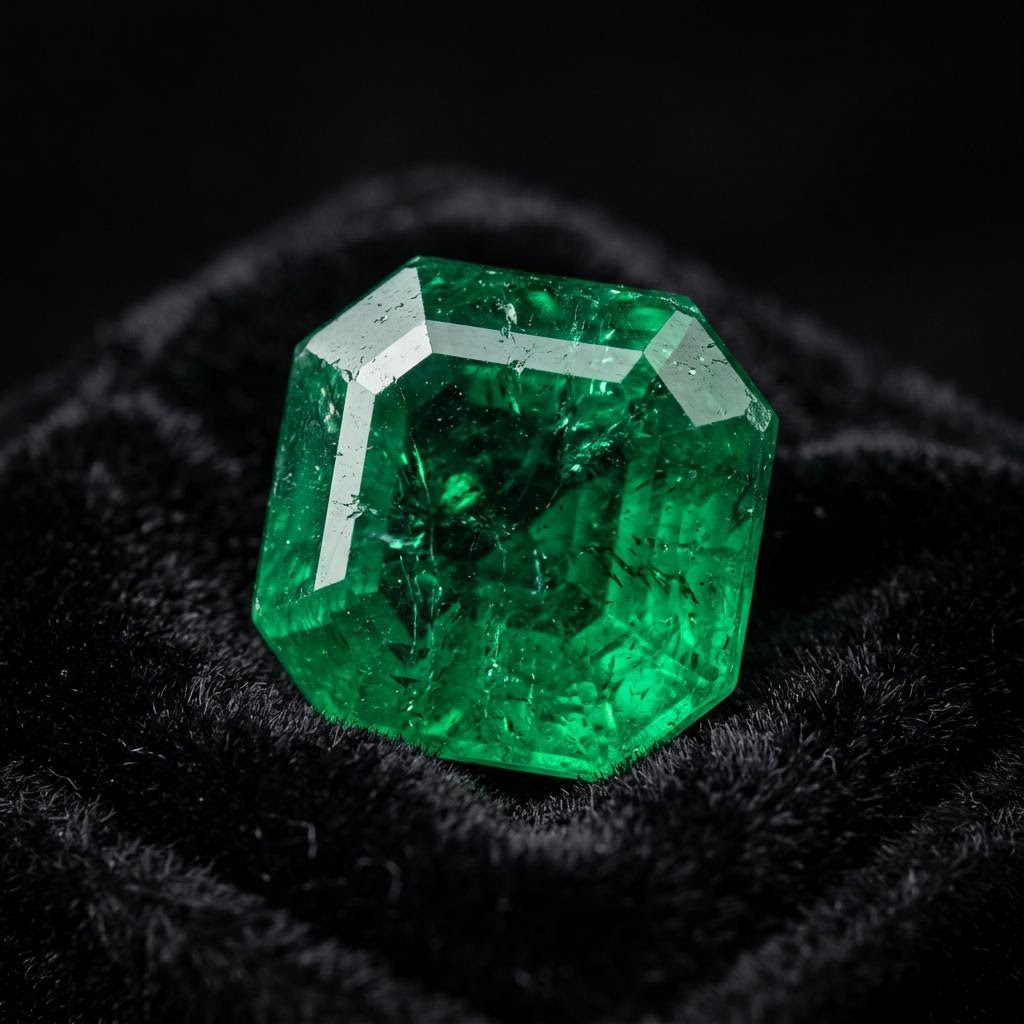
A practical field note on what Emerald is made of, how it forms, how light behaves inside it, and what professionals look for when identifying it.
Browse the plain-language gemstone glossary or learn how to read a lab report.
Representative source regions, not a map of every occurrence.
Muzo and Chivor are classic sources of vivid, often low-iron emeralds.
Kafubu deposits produce bluish-green stones with strong saturation.
Several regions produce emerald in varied host rocks.
Sandawana is known for small, intensely colored crystals.
Panjshir produces emeralds in a complex metamorphic setting.
Color is shaped by chemistry, structure, inclusions, and light. These are representative varieties—not a promise that every stone will show every shade.
Cooler green with a blue component, often seen in some Colombian material.
Highly saturated green is prized when tone and clarity remain balanced.
A warmer green influenced by iron and vanadium content.
Dark tone can be dramatic but may reduce brightness if too inky.
Gemstones have rich symbolic histories. The claims below are presented as folklore, cultural tradition, or modern pseudoscience—not as proven medical, psychological, or supernatural effects.
Historical lens
Ancient Egyptian, Roman, Incan, and medieval European traditions each developed their own symbolic readings.
Historical lens
These stories show how transparency and green color were given moral meaning.
Historical lens
This is spiritual symbolism; it is not a treatment for cardiac, emotional, or other medical conditions.
Gemological properties can be measured and tested. Symbolic meaning is personal and cultural; crystals should never replace qualified medical or mental-health care.
Cleopatra's mines near the Red Sea (now called Wadi Sikait) operated from about 330 BCE under Alexander the Great through Roman times. Cleopatra was so obsessed with emeralds she gave them as diplomatic gifts and claimed ownership of all Egyptian emerald mines. Egyptian emeralds are found in Tutankhamun's tomb.
Roman emperor Nero reportedly watched gladiator fights through a flat emerald as a sunglass for eye strain relief. The Aztecs and Incas had used Colombian emeralds for centuries before Spanish conquistadors arrived in the 1500s. Hernán Cortés looted massive emeralds from Aztec temples—he later lost them all in a shipwreck.
Spain brought Colombian emeralds to Europe and the Middle East in such quantities that they replaced Indian and Egyptian production. Mughal emperors became obsessed—Shah Jahan had the largest known engraved emerald (217.8 ct), used as a talisman. The Mughal Emerald sold for $2.2 million at Christie's in 2001.
Emerald jewelry experienced a renaissance during the Victorian Era as archaeological discoveries of Pompeii inspired Roman Revival styles. Tiffany & Co. popularized emerald cuts specifically to show emerald's color to maximum advantage.
In Vedic astrology, emerald is assigned to Mercury and believed to enhance intellect, communication, and business success. The ancient Egyptians associated emerald with fertility, rebirth, and the goddess Isis. Islamic tradition holds emeralds as the closest gem to paradise—the Throne of God in the Quran is described as surrounded by emerald green. In pre-Columbian South American cultures, emeralds were offerings to gods, buried with nobles, and believed to contain living spirits. European alchemists believed emeralds could grant visions of the future.
Cultural meanings and historical beliefs are included for context. They are not scientific evidence or medical advice.
Medieval Europeans believed emeralds could reveal whether a lover was faithful—the gem would change color when worn by an unfaithful heart. Ancient Romans dedicated emeralds to Venus, goddess of love and beauty. Hindu legend holds that the first emerald was discovered embedded in the forehead of the serpent god Vasuki. The legendary Holy Grail was said to be carved from a single massive emerald.
This section records cultural history and folklore. These stories are not scientific evidence or medical guidance.
Color is paramount for emeralds—the ideal is a vivid, slightly bluish-green (Colombian emeralds set this benchmark). Zambian emeralds are often more included but have deeper, cooler green tones at lower prices. Unlike diamonds, inclusions in emeralds are expected and even celebrated—the French term 'jardin' (garden) affectionately describes the internal landscape. Nearly all commercial emeralds are clarity-enhanced with cedar oil or resin filling (on a scale of 'none' to 'significant'). Request AGL or Gübelin reports specifying treatment level. Significant enhancement reduces value by 30–70%. Be skeptical of deeply discounted 'natural emeralds'—many are synthetic (Chatham, Biron, Gilson) which are virtually impossible to distinguish without lab testing.
Identity: Emerald is the green-to-bluish-green variety of beryl. Its color is caused by chromium and/or vanadium. If the green is too pale, it is classified as green beryl, not emerald.
Color, Clarity & Cut: Compare hue, tone, saturation, transparency, inclusions, cut, and size together. The step-cut commonly called the emerald cut can help protect vulnerable corners, but other outlines are also used.
Treatments: Oil or resin may be used to reduce the visibility of surface-reaching fractures. Look-alikes include green tourmaline, tsavorite garnet, and laboratory-grown emerald.
Care & Wear: Emerald can have surface-reaching fractures and clarity enhancement. Avoid ultrasonic and steam cleaning; when treatment or condition is uncertain, use a dry soft cloth and seek professional guidance before wet cleaning.
Report Considerations: Some laboratories describe the degree of clarity enhancement using their own terminology. Review the report's scope and wording rather than assuming all laboratories use identical categories.
Browse our current, authentic collection of natural emeralds on eBay.