Brazil
The leading source of massive rose quartz and fine specimens.
Crystals gemstone profile
A Long-Standing Symbol of Love & Compassion
Rose quartz is a translucent pink variety of quartz long used in jewelry, decorative arts, and love symbolism. Claims that it restores relationships or provides inner healing are modern spiritual beliefs, not scientifically demonstrated effects.
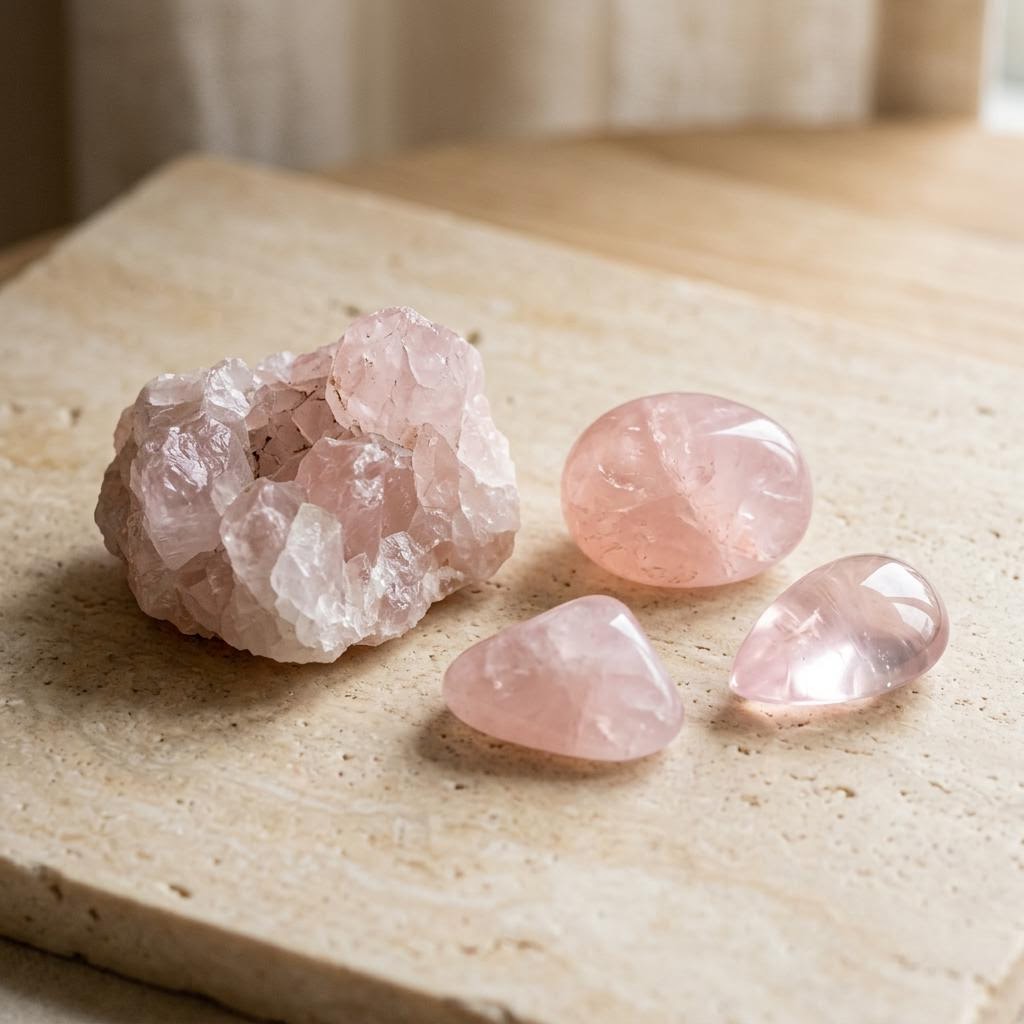
A practical field note on what Rose Quartz is made of, how it forms, how light behaves inside it, and what professionals look for when identifying it.
Browse the plain-language gemstone glossary or learn how to read a lab report.
Representative source regions, not a map of every occurrence.
The leading source of massive rose quartz and fine specimens.
Known for transparent pink crystals and star rose quartz.
South Dakota and Georgia produce rose quartz.
Produces pale pink massive quartz.
Source of decorative rose quartz material.
Color is shaped by chemistry, structure, inclusions, and light. These are representative varieties—not a promise that every stone will show every shade.
Very light pink bodycolor with a soft, translucent appearance.
Classic warm pink caused by microscopic inclusions or structural color centers.
A warmer pink tone that can overlap with pale orange.
Oriented inclusions can create a six-ray star in cabochons.
Cooler pink with a subtle violet cast in some material.
Gemstones have rich symbolic histories. The claims below are presented as folklore, cultural tradition, or modern pseudoscience—not as proven medical, psychological, or supernatural effects.
Historical lens
Its gentle pink color has made it a modern symbol of affection and tenderness.
Historical lens
Historical uses varied, and modern metaphysical meanings should not be projected onto every ancient artifact.
Historical lens
It can be a meaningful reminder or ritual object, but it has no demonstrated ability to treat emotional or cardiac conditions.
Gemological properties can be measured and tested. Symbolic meaning is personal and cultural; crystals should never replace qualified medical or mental-health care.
Rose quartz facial masks dating back to 7000 BCE have been found in Egyptian tombs. They believed it prevented aging and preserved a beautiful complexion.
Assyrians crafted rose quartz jewelry around 800–600 BCE. Romans used it to craft intricate ownership stamps and seals, and as an ingredient in love potions.
Today, rose quartz is one of the most popular crystals in jewelry and décor, widely recognized as a modern symbol of unconditional love. It is also used in skincare tools such as gua sha stones and face rollers; the tools' physical massage action should be distinguished from unproven claims about the mineral itself.
Cultural meanings and historical beliefs are included for context. They are not scientific evidence or medical advice.
Greek and Roman myths claim that Cupid (Eros) brought rose quartz to earth to bestow love, passion, and warmth upon humanity. Another legend says it was formed when the blood of Aphrodite and her lover Adonis mixed and stained white quartz pink after they were attacked by Ares in the form of a wild boar.
This section records cultural history and folklore. These stories are not scientific evidence or medical guidance.
Rose quartz usually occurs in massive form, meaning it rarely forms distinct geometric crystals. Deep, vibrant pink pieces are more valuable than pale ones. 'Star' rose quartz, which displays a six-rayed star when polished into a cabochon and viewed under a direct light, is highly prized by collectors.
Browse our current, authentic collection of natural rose quartzs on eBay.